Transforming your basketball court into a premier sporting, have involves more than just game itself. This is about crafting immersive experience for all player and spectator alike. Upgrading court into hardwood floor basketball court will be increase the atmosphere and making vibrant hub for community engagement.
Voting for top notch features like a hardwood floor basketball court, add extra layer of excellence. Surely its providing players with a surface that combines both durability and performance. From cutting edge technology to choice of material, each upgrade contributes to smooth blend of functionally & aesthetic court. All component mixed and merge ensuring that every dribble, pass, and slam dunk becomes a memorable event.
That, its too crucial to carefully consider the type of basketball court, you need prepred everything as well.
Understanding the Basketball Court You Need
Opting the right basketball court involves a global consideration of various factors, align standards & requirement for your basketball court. For professional or competitive play, choosing for a hardwood floor basketball court offers distinct advantages.
Considerations include to specific dimensions set by relevant basketball leagues, evaluating the surface material’s durability and player-friendly properties (commonly hardwood, such as maple), ensuring accurate court markings for fair gameplay, assessing traction and safety features, exploring customization options for team branding, recognizing the aesthetics that contribute to the game’s visual appeal, understanding the historical significance of hardwood floors in basketball, and acknowledging the manageable maintenance requirements of hardwood surfaces.
The fact about hardwood floor basketball court, this wood provides unparalleled benefits, including a consistent and predictable ball bounce. Much advantage will enhances skill development, enduring durability, player-friendly traction, and customized opportunities that enhance the overall playing experience. When combined the beauty of the wood with its historical significance, it makes it a symbol that is widely appreciated by players and fans. In conclusion, the choice stand out for consistency, durability, player characteristic, and overall enriching experience it offers.
What the Standards Require for Sports Hall Flooring in the UK?
In the UK, sports hall flooring procurement is shaped by a specific set of standards and guidance documents that most buyers encounter only when a project is already underway. Understanding them at the outset saves time, prevents specification errors, and gives any contractor or supplier you engage a clear brief to work to.
Sport England Technical Guidance
Sport England is the primary body shaping sports facility design standards in England, and its technical guidance documents are the starting point for any school, leisure centre, or publicly funded sports hall project. Sport England references EN 14904 as the operative performance standard for indoor sports surfaces and provides specific guidance on sports hall dimensions, surface requirements, and equipment specifications. For school projects in particular, whether new build or refurbishment, Sport England compliance is not optional. It is the benchmark that Local Authorities, Multi-Academy Trusts, and ESFA-funded projects will require contractors to meet before sign-off.
The practical implication for floor specification is that any product proposed for a UK school or publicly funded leisure centre must come with documented EN 14904 test results for the complete system, not just the surface board. Suppliers who cannot provide this documentation should be treated with caution regardless of how their product is presented.
EN 14904: The European Standard That Still Governs UK Sports Floors
EN 14904 remains the operative standard for indoor sports surfaces in the UK following Brexit. It has not been replaced by a domestic alternative, and the vast majority of UK public sector procurement frameworks continue to reference it explicitly. The standard covers six core performance properties: shock absorption, vertical deformation, ball rebound, surface friction, rolling load resistance, and flatness. For basketball specifically, the most important of these are shock absorption (the floor must absorb at least 25 percent of the impact force compared to concrete), ball rebound (the floor must return at least 90 percent of the rebound achievable on a rigid surface), and surface friction (the coefficient must fall within a defined range that provides safe traction without causing excessive grip or slip).
A floor classified as EN 14904 Class A3 meets the minimum standard for competitive basketball use. Class A4 represents the higher performance tier appropriate for elite and national-level competition. For the majority of UK school and leisure centre projects, A3 is the relevant specification. For facilities in the East Midlands serving county-level or national programmes, A4 is worth considering.
FIBA Standards for Competition Courts
If your facility will host formal competitive basketball, FIBA performance requirements apply alongside EN 14904. FIBA specifies minimum ball rebound of 90 percent relative to concrete, shock absorption of at least 25 percent force reduction, and a surface friction coefficient between 0.4 and 0.6 across the full court area. Any supplier should be able to confirm FIBA compliance explicitly and in writing. A verbal assurance is not sufficient for a project that will go through formal procurement.
Understanding Your Facility Type and What It Actually Needs
One of the most common specification mistakes in UK sports hall projects is treating all facilities as though they have the same requirements. A school sports hall in Haringey, a leisure centre managed by a Manchester City Council contractor, and a boutique private gym in a London office conversion have almost nothing in common beyond the fact that basketball will be played on the floor. Getting the specification right starts with understanding which category your facility falls into.
| Educational Sector: Academies, Schools, and Universities The educational sector represents the UK’s largest sports flooring market, governed by rigorous procurement and multifunctional performance standards. Since these halls must transition seamlessly from high-impact PE sessions to community events and heavy examination seating, the floor requires a proven 25-year lifespan and immense structural durability. For any school project, Sport England compliance and EN 14904 certification are non-negotiable benchmarks that ensure safety and long-term asset reliability. Consequently, elite institutions like Loughborough University demand even higher performance tiers to support their world-class athletic and sports science programs. | Leisure Centres: Public Sector and Local Authority Facilities Local authority leisure centres prioritize whole-life cost modelling, often favoring premium surfaces that extend refinishing cycles and simplify routine maintenance over cheaper upfront alternatives. In regenerating urban hubs like Manchester and Liverpool, these floors must withstand an intense community use case that transitions from multi-sport athletics during the day to heavy foot and furniture traffic in the evening. This demands a robust finish capable of tolerating everything from netball matches to community markets without showing premature wear or structural damage. Consequently, a successful specification in this sector must balance versatile line configurations with a durable, high-performance surface that justifies the initial capital investment through long-term operational savings. | High-End Residential and Boutique Gyms The private indoor court segment across major UK cities represents a luxury market where bespoke aesthetics and deep customization often take precedence over standard procurement frameworks. Unlike public facilities, these high-end residential and boutique gym projects prioritize a visual character that seamlessly integrates with sophisticated interior design, allowing for custom graphics and unique finishes. Jati Luhur Agung’s premium tropical hardwoods, such as Teak and Acacia, offer a compelling alternative to common Maple by providing a distinct, high-end look that adds significant value to the space. While performance certification remains a necessity, the decision-making process for these elite clients begins with the desire for a world-class surface that is as visually stunning as it is functional. |
What Makes a Basketball Floor a Performance System, Not Just a Surface
The most important thing to understand about a compliant basketball floor is that the performance is delivered by the system as a whole, not by the surface timber alone. This is the point that distinguishes a well-specified sports hall floor from a hardwood floor that happens to be installed in a sports hall, and it is the distinction that matters most when comparing supplier proposals.
The Subfloor System: Where Performance Actually Lives
A certified sports hall floor is built in three functional layers. The lowest layer is the resilient system: rubber pads, springs, or a foam composite that sits on the structural concrete subfloor and is responsible for shock absorption. This layer is what allows the floor to meet EN 14904 shock absorption requirements. Without it, any hardwood surface, regardless of species or quality, is effectively a rigid surface and will fail the standard. Above the resilient layer sits the batten or sleeper framework, which distributes load evenly and creates a platform for the surface boards. The surface layer, the hardwood you see and play on, provides traction, ball rebound consistency, and the visual finish of the court.
When a buyer focuses only on the surface timber and treats the subfloor as an afterthought or a cost to be minimised, the result is almost always a floor that either fails compliance testing or deteriorates far faster than expected. This is particularly relevant in UK school and leisure centre projects where the floor will be subjected to multi-use loading, including examination chairs and heavy trolleys, that a sports-only subfloor design may not anticipate. Jati Luhur Agung supplies the complete system: subfloor construction, surface hardwood, game line paint, and finish coats, all under a single warranty. This eliminates the accountability gap that arises when different components come from different suppliers.
Ball Rebound and Shock Absorption: What the Numbers Mean
EN 14904 ball rebound measures how consistently the basketball bounces relative to a rigid concrete surface. A minimum of 90 percent is required, meaning a ball dropped from a given height must rebound to at least 90 percent of the height it would reach on concrete. This consistency is what allows players to develop reliable shooting and dribbling technique. A floor that passes this test in isolation but degrades quickly under use, losing rebound consistency as the surface wears, provides a false assurance. Ask any supplier how their ball rebound figure changes after ten years of use and typical maintenance cycles, not just at installation.
Shock absorption measures the reduction in peak force that the floor provides relative to concrete. At 25 percent minimum, this means the floor absorbs at least a quarter of the impact energy that would otherwise travel directly into a player’s joints on every landing. For a school or leisure centre where the same players are using the floor multiple days per week across years of training, the cumulative effect of adequate versus inadequate shock absorption on injury rates is significant. Facilities in Loughborough and Leicester working with athletes in structured training programmes should consider specifying above the A3 minimum for this reason.
Multi-Sport Line Configuration
Very few UK sports hall floors are used for basketball alone. A standard multi-sport line configuration includes court markings for basketball, netball, badminton, and five-a-side or futsal, using different colours for each sport to maintain visual clarity. The game line painting process, when done correctly, uses sport-specific paints that do not affect the friction characteristics of the surface and are integrated into the finishing process rather than applied on top of the final coat. A supplier who paints lines over a finished floor rather than under the final coat is providing a system that will show wear at the line boundaries far earlier than one where the lines are properly integrated.
Hardwood vs Other Basketball Floor Materials: An Honest Comparison for UK Buyers
UK buyers sometimes arrive at a sports hall flooring project with the assumption that hardwood is automatically the right answer. In most cases it is, particularly for permanent installations with a long asset life requirement. But the honest answer depends on the facility type, the usage pattern, and the budget horizon. Presenting the alternatives fairly helps buyers make the right decision rather than the conventional one.
The Benchmark is Solid Hardwood
Solid hardwood is the performance benchmark for competitive basketball floors and the material specified in virtually all elite and high-performance facilities. Its advantages are well established: consistent ball rebound, excellent long-term traction, the ability to be sanded and refinished multiple times over a 30 to 40-year lifespan, and a visual quality that communicates seriousness of purpose in a competitive environment. For a school in Hackney that wants its sports hall to function as a genuine performance venue for its basketball programme, or for a training facility in Loughborough serving county or national athletes, solid hardwood is the appropriate specification.
The tropical hardwoods offered by Jati Luhur Agung, including teak and acacia species, provide equivalent or superior performance to the maple that dominates North American specifications and the European beech common in competitor products. Tropical hardwoods offer exceptional density and natural moisture management properties that are genuinely valuable in UK sports halls, where the combination of playing use, cleaning cycles, and varying ambient humidity creates a more demanding environment for the surface than a dry, climate-controlled arena. All JLA timber is FSC-certified and SVLK-verified, satisfying the sustainability requirements that architects and procurement officers in the UK increasingly apply as a condition of specification.
Engineered Sports Wood
Engineered sports flooring, with a real hardwood veneer bonded to a plywood or composite core, is a legitimate option for mid-range specifications where budget is constrained but EN 14904 compliance is still required. It performs well, is available with full certification, and sits below solid hardwood on initial cost. The trade-off is longevity and refinishing potential. An engineered surface can typically be sanded once or twice before the veneer is exhausted, compared to five or more refinishes for solid hardwood. For a 25-year asset management horizon, this means the floor may need full replacement where solid hardwood would simply need a refinish. Whole-life cost modelling almost always favours solid hardwood for facilities with long-term asset plans.
Synthetic Modular Systems
PVC and polypropylene modular court systems are appropriate for temporary courts, multi-purpose event spaces where the floor needs to be installed and removed regularly, and outdoor or semi-outdoor applications. They cannot meet the EN 14904 A3 or A4 shock absorption and ball rebound requirements needed for competitive basketball in a permanent installation, and they should not be specified for school sports halls or leisure centres where Sport England compliance is required. Their legitimate use case is temporary courts at events, portable practice surfaces, and outdoor installations where a permanent hardwood floor is not practical.
Hardwood Floor Offers Unmatched Performance
The choice of hardwood for basketball court flooring is deeply rooted in its ability to provide unmatched performance. Here are several factors that contribute to the superior performance of hardwood floors in the context of basketball:

1. Consistent Ball Bounce
Hardwood floors offer a consistent and predictable bounce of the basketball. Its is crucial for players to develop their shooting, passing, and dribbling skills.
2. Impact Absorption
Hardwood provides a level of impact absorption, reducing the stress on players’ joints and muscles. This is particularly important in a high-impact sport like basketball.
2. Impact Absorption
Hardwood provides a level of impact absorption, reducing the stress on players’ joints and muscles. This is particularly important in a high-impact sport like basketball.
3. Durability and Resistance
Hardwood, especially maple and the other of wood sport flooring, is known for its durability and resistance to wear and tear. It can withstand the constant pounding of basketball shoes, making it a long-lasting flooring option.
4. Traction and Grip
The surface of hardwood floors is designed to offer optimal traction and grip. This is essential for players making quick movements, cuts, and changes in direction without the risk of slipping.
5. Precision Ball Handling
The smooth surface of hardwood allows for precise ball handling. Players can execute intricate moves with confidence, knowing that the ball will respond predictably to their actions.
6. Squeak Sound
The squeaking sound of shoes on hardwood is not just iconic; it also indicates the level of grip and traction. The sound is a part of the game’s auditory experience and contributes to the overall atmosphere.
7. Visual Clarity
The color of the hardwood floor provides visual unique, allowing players and officials to identify court markings, such as the three-point line and free-throw line.
8. Customized for Performance
Hardwood floors can be customized to meet specific performance requirements. For example, the specific type of finish applied can influence the level of friction and speed of the game.
9. Low Maintenance Requirements
While regular maintenance is essential, hardwood floors generally have lower maintenance requirements compared to alternative surfaces. Proper care ensures the longevity of the floor.

10. Aesthetic Motivation
The aesthetics of a hardwood floor can motivate players. The polished and professional appearance of the court contributes to a positive playing environment.
11. Historical Significance
Many historic moments in basketball have taken place on hardwood floors. The sense of history and tradition associated with hardwood can inspire players to perform at their best.
Provides Safer Traction
The traction that players get will be safer, because the hardwood floor used provides comfortable resistance. Here are several reasons why hardwood floors excel in offering a safe playing surface:
1. Optimal Friction Levels
Hardwood surfaces are carefully finished to achieve optimal friction levels. This ensures that players can maintain control and traction during quick movements without the risk of slipping.

2. Consistent Grip
The smooth yet textured surface of hardwood allows for a consistent grip on the court. This is essential for players making cuts, pivots, and sudden changes in direction.
3. Reduced Slippage
The design of hardwood floors minimizes slippage, providing a stable surface for players. This is crucial in preventing accidental falls and injuries during the fast-paced and dynamic nature of basketball.
4. Customizable Finish
The finish applied to hardwood floors can be customized to achieve the desired level of grip. Courts can be tailored to the specific needs of the players and the style of play in a particular league or competition.
5. Sweat and Moisture Management
Hardwood has natural properties that help manage moisture. Properly maintained hardwood floors can absorb and release moisture, preventing the build up of sweat and maintaining a safe level of traction.
6. Impact on Player Safety
Traction plays a crucial role in preventing injuries such as ankle sprains and slips. The hardwood surface, when maintained correctly, contributes to the overall safety of the players on the court.
7. Quick Drying Time
Hardwood floors dry relatively quickly, minimizing the time the surface remains slippery after cleaning or in the presence of moisture. This quick drying time enhances the safety of the playing environment.
8. Consistency Across The Court
Hardwood offers a consistent level of traction across the entire court. This uniformity is important for players who need to trust that their movements will be consistent, regardless of their position on the floor.
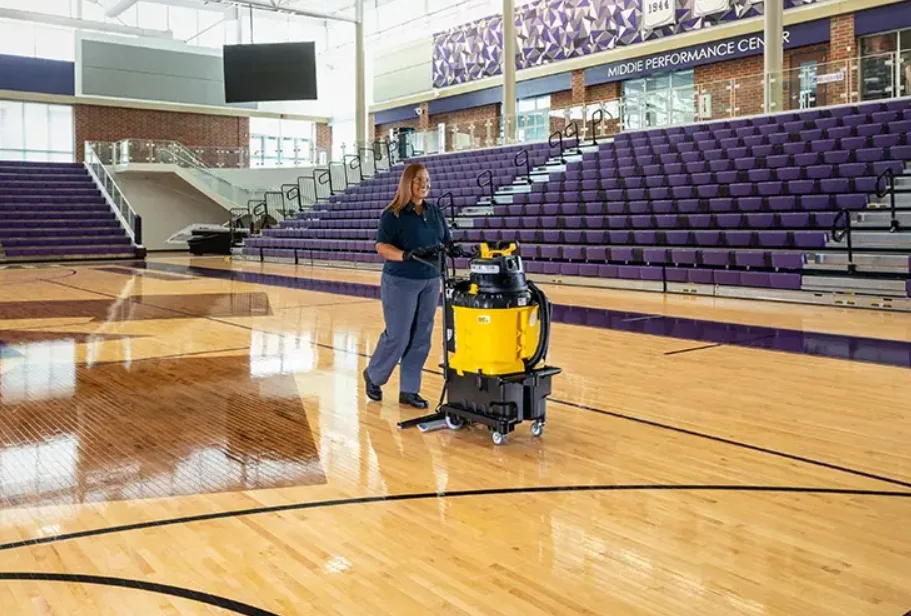
9. Long-Term Performance
Hardwood’s durability ensures that the traction properties remain consistent over the long term. Unlike other surfaces that may degrade, hardwood maintains its integrity, providing a reliable playing surface throughout its lifespan.
10. Compliance with Safety Standards
Basketball courts, including their hardwood floors, must meet safety standards set by organizations such as FIBA and the NBA. The specifications for traction and slip resistance are considered in these standards to ensure player safety.
Court Design, Custom Markings, and Bespoke Finishing
The visual presentation of a basketball court is more significant than many facility managers initially assume. For schools with active basketball programmes in London, the court is part of the facility’s identity. For boutique gyms and private courts, it is a design statement. For community facilities in Manchester and Liverpool, it is a source of local pride. Getting the court design right is not a cosmetic consideration. It is part of what the facility delivers to its users.
Multi-Sport Line Markings
A standard UK sports hall line configuration includes court markings for basketball, netball, badminton, and indoor football or futsal. Each sport uses a distinct line colour to maintain clarity when multiple configurations are marked on the same surface. The standard approach is to use a single dominant colour for the primary sport, with secondary and tertiary sport lines in colours that do not visually conflict. Basketball courts in UK schools typically use a red or orange key area with white boundary and centre lines, with badminton lines in yellow and netball in blue or green.
The line painting process matters as much as the colour choice. Lines applied under the final finish coat, rather than on top of it, are significantly more durable and do not create a friction differential at the line boundary that can affect player movement. Jati Luhur Agung integrates game line painting into the finishing process, ensuring that markings are protected by the final topcoat and perform consistently with the rest of the surface.
Custom Court Graphics and Branding
For schools, academies, and private clubs with strong team identities, custom court graphics represent a meaningful investment in the facility’s culture and in player motivation. Centre court logos, team crests in the key area, custom colour palettes for the three-point zone, and branded half-court designs are all achievable on a hardwood sports floor when specified correctly. The process requires UV-resistant inks and a clear protective topcoat that maintains the graphic without affecting the surface friction characteristics of the court.
Jati Luhur Agung can accommodate bespoke court design requirements for both standard and custom installations. Whether the brief is a simple school crest in the centre circle or a fully branded court with custom key colours and perimeter graphics, the design and finishing team can work to the specification. For boutique gym projects in London where the court is a centrepiece of the interior design, this capability is particularly relevant.
Portable and Temporary Court Solutions
For venues that need a basketball court without a permanent installation, portable interlocking court systems provide a practical solution. These systems can be installed over an existing hard floor without adhesive, configured to any court size, and removed and stored when the space is needed for other purposes. They are widely used in event venues, conference centres, and multi-purpose halls across the UK where a permanent installation is not feasible. Jati Luhur Agung can advise on both permanent and portable configurations and can supply systems appropriate for the specific use case and space.
Maintenance, Lifespan, and Total Cost of Ownership
UK facility managers are under consistent budget pressure, and the most effective argument for investing in a well-specified sports hall floor is the total cost of ownership over the asset’s life, not the upfront capital cost. A solid hardwood floor specified correctly and maintained properly will outperform and outlast any lower-cost alternative by a margin that makes the initial investment rational even under tight capital constraints.
Lifespan and Refinishing Cycles
A well-specified solid hardwood sports floor in a UK school or leisure centre, maintained according to the manufacturer’s guidance, should deliver a 30 to 40-year service life. Over that period, the floor will typically require a full sand and refinish every eight to fifteen years depending on usage intensity, and a screen and recoat of the surface finish every three to five years to maintain protection. Each refinish restores the surface to near-original condition without replacing the structural elements of the floor. The capital cost of a refinish is a fraction of full replacement, and a floor that is properly maintained through refinishing cycles should never need full structural replacement within its design life.
Daily and Weekly Maintenance
The maintenance requirements for a hardwood sports floor are straightforward and do not require specialist contractors for routine care. Daily dry dust mopping to remove grit and debris prevents the surface abrasion that is the primary cause of finish wear in high-traffic sports halls. Weekly damp mopping with a pH-neutral wood floor cleaner removes accumulated dirt without damaging the finish. The most common maintenance mistake in UK schools is using general-purpose cleaning products or steam mops on hardwood sports floors. Both damage the finish and, over time, the surface itself. A simple laminated maintenance guide posted in the cleaning room is worth more than most additions to a maintenance budget.
Whole-Life Cost Comparison
When comparing a solid hardwood system at a higher upfront cost against a synthetic or lower-grade alternative, the total cost calculation over 30 years almost always favours hardwood. A synthetic modular floor requiring replacement every ten to twelve years produces two full replacement cycles within a 30-year horizon, whereas a solid hardwood floor requires only maintenance and periodic refinishing. Add the avoided disruption cost of two full floor replacement projects, and the lifecycle cost advantage of the hardwood system is significant. For local authority procurement officers who need to present whole-life cost data to justify capital spend, this calculation is worth preparing explicitly in any specification document.
If you’re passionate about creating a safer and optimal playing environment for basketball, consider upgrading your court to a hardwood floor. Experience the benefits of safer traction, optimal friction, and consistent grip, all of which contribute to enhanced player safety.
Visit us to explore a wide range of hardwood flooring options for basketball courts. Elevate your game and prioritize safety by choosing hardwood. Your players will thank you, and the game will reach new heights. Upgrade today with Jati Luhur Agung!
- By:PT. Jati Luhur Agung
- Tags: basketball court, hardwood floor basketball court, upgrade basketball court
- Category: Sports Floor
- 0 comment