Do you want to keep the kitchen countertops at home in good shape? Well, the cutting board could be said as one of the key accessories for the kitchen décor. However, to provide a durable and hygienic place to slice any ingredients, you need to be careful and selective in choosing the best wood for the cutting board.
As we know, cutting boards are available in different types, shapes, and sizes. Moreover, although it is made from wood –as the main material, some different woods are used to make it. Here, we will talk to you about the kinds of the best wood to make a cutting board and what to consider in choosing it. For those who are curious about it, please read the following writings below.
In the Netherlands, the kitchen is rarely just a place to cook. It is where the borrel happens, where guests linger, and where a well-chosen cutting board sits at the centre of the table long after the chopping is done. That is why Dutch consumers tend to approach the purchase of a wood cutting board differently from most: not as a functional tool to be replaced every few years, but as a considered investment in something that will perform well, age beautifully, and say something about the care put into the home.
Yet for all the interest in premium kitchen accessories, the market for wood cutting boards in the Netherlands is full of options that look similar but perform very differently. The species of wood, the grain orientation, the finish, and the source of the timber all have a real impact on how long a board lasts, how safe it is for daily use, and whether it is genuinely worth the price. This guide cuts through the noise and gives you a clear, honest picture of what to look for, so you can make a choice you will still be happy with a decade from now.
Why Wood Beats Plastic in the Kitchen It Matters More Than You Think
The debate between wood and plastic cutting boards has been running for decades, and the answer is less straightforward than most product descriptions suggest. Plastic boards are easy to clean and inexpensive, but they develop deep knife grooves over time that are almost impossible to sanitise properly. Research from the University of California found that bacteria trapped in the grooves of a plastic board survive and even multiply, while bacteria drawn into the surface of a wood board tend to die off naturally. This is not a small detail — for anyone using the same board for raw meat and fresh produce, it matters considerably.
Wood also has a significant advantage when it comes to knife care. Glass, ceramic, and hard plastic surfaces wear down blade edges quickly, meaning you will be sharpening or replacing knives far more often. A properly finished wood cutting board is firm enough to provide resistance but forgiving enough to protect the edge of a quality knife. For Dutch home cooks who invest in good knives, a Wusthof, a Victorinox, or a Japanese blade — this is a practical argument, not just an aesthetic one.
From a sustainability standpoint, wood has a clear edge as well. A quality wood cutting board made from certified timber lasts ten to twenty years with proper care. A plastic board typically needs replacing within two to four years. Over the lifetime of a household, the environmental footprint of wood, especially FSC-certified or SVLK-verified tropical hardwood is significantly lower than the cumulative waste of multiple plastic replacements. For consumers in Amsterdam, Utrecht, and Haarlem who already check labels and care about sourcing, this is often the deciding factor.
Why Choosing Wood Instead of Other Materials for Cutting Boards?
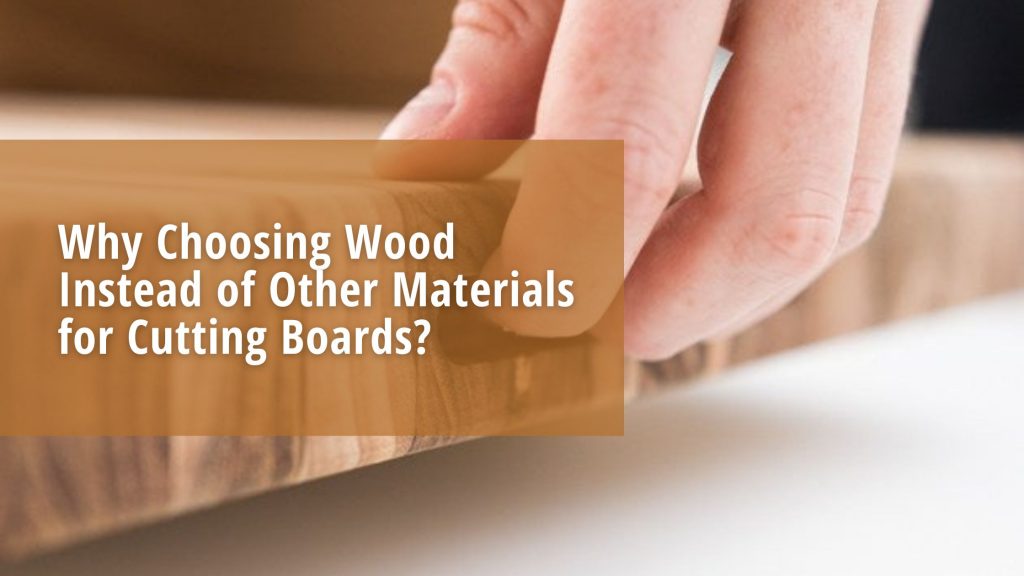
When you are looking for a new cutting board on the market, we realize that you will find many kinds of cutting boards made from different materials, such as wood, plastic, or maybe metal. Then, the question is why choose wood for your favorite cutting board material?
By the characteristics of its surface, wood will protect the knives. The wood cutting board will not dull them like the other cutting board materials, like ceramic, glass, and plastic. It means that you could use your favorite knife longer.
On another hand, durability also becomes the issue why many people choose the wood cutting board. It cannot be denied that the wood cutting board could get scratched. However, many professionals will be ready to refinish it.
If you want to find a good cutting board with a unique natural appearance. the wooden cutting board is also the best option. You could choose edge grain butcher block, end grain butcher block, wide plank, live edge, and others with unique style and construction. We are sure that it will influence the whole sense of kitchen décor.
The last but not least, the wooden cutting board is also easy to maintain. After using it, you just need to clean the cutting board by washing it. When the color of the wood faded away, you could use oil to make it newer.
What to Consider in Choosing The Best Wooden Cutting Board?

There are some matters to consider in choosing the best wooden cutting board. Of course, the appearance of the cutting board becomes the first matter to consider. Here, you need to consider some aspects, such as size, shape, or other matters just to make sure that it is the wooden cutting board that you want.
Besides, you also need to consider hardwood and softwood as an option. The hardwood is very interesting, especially for its durability. With its characteristics, the hardwood cutting board could be used for years and is free from scratchers. However, softwood also could be alternative. It has good characteristics and durability. Moreover, it is cheaper.
However, to consider the hardness level of the cutting board, you should apply the Janka scale. Try to get the information about it before choosing the best cutting board.
Read More : 6 Best Type of Custom Wood Cutting Board for your Kitchen
Choosing the Right Wood Species for the Dutch Kitchen

Then, what is the best wood for cutting board that we may choose?
As we have said before, many kinds of wood are applied to make a cutting board. Some kinds of wood that could be the best material for a durable cutting board are:
Maple
Maple, especially the hard maple or sugar male, is the most popular wood for cutting boards. This wood is hard and close-grain wood. It means that a cutting board made from maple is durable and resists bacteria.
Another interesting matter about maple is this wood is light and fairly neutral in color. It means that using maple as a cutting board will be easy and this cutting board could be applied to the different styles of kitchen décor.
Acacia
It could be said that acacia is not a common material for cutting boards. However, this wood idea is nice since it is durable and versatile. It means that acacia could be applied to make different stuff in the kitchen.
Some people said that acacia is also interesting because of its cheaper price. Moreover, acacia is rather easier to be found on the market.
Cherry
Cherry becomes the next-best wood that could be applied to make a cutting board. This wood is a hard and closed-grain wood. That is why cherry becomes the top option for cutting boards.
Besides its high hardness level, cherry is also interesting with its appearance. Naturally, it has a medium to dark color. With its unique appearance, we believe that the cherry cutting board will increase the timeless beauty inside your kitchen.
A cutting board made from cherry is also easy to care for. Then, it also will not dull the knives.
Walnut
Similarly, walnut is another nice hardwood and it is excellent to be applied as the cutting board material. Many people said that walnut is very interesting, especially with its high hardness level. It means that a walnut cutting board is hard to be broken and could be used for years.
On another hand, walnut is also interesting in its appearance. Naturally, walnut has dark color as the main appeal. For those who want to get a high level of nature inside the kitchen décor, this wood option is the best choice.
Teak
Teak has been prized for its durability and ease of maintenance. This wood also maintains a natural appearance, so many people like to choose it for their furniture. Of course, to be made as a cutting board, teak will provide a durable board that could be used for years.
Unfortunately, teak has been exploited for several years. The African teak, for example, now become an endangered wood species.
Bamboo
Another kind of wood that is also great to be chosen as a cutting board material. Technically, bamboo is not wood, but it is grass. However, modern technology worked amazingly to make this grass into a durable cutting board.
Bamboo is quite interesting as a cutting board material since it is hard and absorbs less water than several different types of wood. On another hand, a cutting board made from bamboo is also easy to maintain. Additionally, bamboo grows quite quickly, so it is sustainable to produce.
The Borrelplank Factor: When a Cutting Board Becomes Part of the Table
If you spend any time in Dutch kitchens, you will notice that the cutting board rarely stays in the kitchen. It moves to the table. It holds the borrelhapjes, the cheese, the charcuterie, the bread, the olives. It becomes part of how the meal is presented, and in open-concept homes in Rotterdam and Amsterdam, it is often the first thing guests notice. This is the borrelplank culture, and it has fundamentally changed what Dutch consumers expect from a wood cutting board.
A board that doubles as a serving platter needs to be two things at once: tough enough to handle a chef’s knife and visually striking enough to sit at the centre of a dining table. This rules out most mass-produced boards immediately. A flat, pale, featureless piece of beech has its uses, but it does not make an impression. What does make an impression is a wide slab of dark walnut with natural grain variation, or a live-edge teak board with an irregular outline that looks like it came directly from the tree. These are boards that people comment on, and in a market where the gift economy around home and kitchen products is strong, that matters.
The practical implication is that for many Dutch buyers, a single premium board now replaces what used to be two separate purchases: a workhorse cutting board and a separate serving board or cheese board. Investing in one well-made piece that does both jobs is very much in line with the Dutch quality-over-quantity approach to household goods.
End-Grain vs Edge-Grain: Understanding the Difference Before You Buy
This is the question that separates a considered purchase from an impulse buy. The construction method of a wood cutting board determines how it performs under daily use, how long the surface lasts, and how forgiving it is on knife edges. Understanding the difference is straightforward once you know what to look for.
End-Grain Boards
An end-grain board is constructed so that the cut ends of the wood fibres face upward, the surface you see is the cross-section of the wood, not its length. This means that when a knife blade contacts the surface, it enters between the wood fibres rather than cutting across them. The fibres part slightly, allow the blade to pass, and then close back up. The result is a surface that is exceptionally gentle on knife edges and resists scoring and scarring far better than other construction types over time.
End-grain boards are widely considered the professional standard. They are also heavier, more expensive to produce, and require a higher quality of wood, because the internal structure of the timber is visible, any defects or inconsistencies in the grain are immediately apparent. For Dutch home cooks who use their board daily and care seriously about knife maintenance, an end-grain board is the most rational long-term investment. In terms of aesthetics, the cross-section pattern of an end-grain board also has a distinct visual appeal that works particularly well as a borrelplank.
Edge-Grain Boards
An edge-grain board is constructed with the long edge of the wood facing upward, the grain runs parallel to the surface. These boards are more common, easier to produce, and generally less expensive than end-grain equivalents. They are also lighter, making them easier to handle for everyday tasks. The surface will show knife marks more quickly than end-grain, but with regular oiling and occasional sanding, an edge-grain board made from a dense hardwood can last for many years.
For buyers who want a quality wood board at a more accessible price point, or who prioritise a flatter, more even surface for tasks like rolling pastry, an edge-grain board is a strong choice. Many of the large-format boards popular for borrel presentation use edge-grain construction precisely because the wide, uninterrupted grain pattern of a plank like teak or walnut is visually dramatic and well suited to serving.
Sustainability and Certification: What to Check Before You Buy
Dutch consumers are among the most sustainability-conscious in Europe, and the kitchenware market is no exception. When it comes to wood products, the question of where the timber comes from and how it was harvested is not a niche concern, it is a mainstream consideration for a significant portion of buyers in Amsterdam, Utrecht, and beyond. Retailers and wholesalers are equally attentive: the major Dutch kitchen and home stores increasingly require certified sourcing documentation before listing a product.
The two most relevant certifications for wood cutting boards sold in the Netherlands are FSC (Forest Stewardship Council) and PEFC (Programme for the Endorsement of Forest Certification). Both certify that timber has been harvested from responsibly managed forests with chain-of-custody tracking from source to finished product. For tropical hardwoods such as teak, these certifications are particularly important because the history of unsustainable teak harvesting is well documented and Dutch buyers are aware of it.
For Indonesian timber specifically, there is an additional layer of verification worth knowing: the SVLK (Sistem Verifikasi Legalitas Kayu), which is Indonesia’s mandatory legal timber verification system. SVLK certification is required for all Indonesian wood exports and confirms that the timber has been legally harvested under Indonesian forestry law. Jati Luhur Agung operates with full SVLK verification alongside FSC certification, meaning that the teak and other tropical hardwoods supplied carry documentation that satisfies even the most rigorous Dutch procurement requirements — whether for retail, hospitality, or B2B supply.
How to Care for a Wood Cutting Board: A Practical Maintenance Guide
A premium wood cutting board is not a set-and-forget purchase, but the maintenance it requires is genuinely simple and takes very little time. Dutch buyers who understand this tend to keep their boards for decades. Those who do not often assume the board is failing when it is simply drying out and needs attention.
Daily and Weekly Care
After each use, wash the board with warm water and a mild dish soap. Rinse promptly and dry immediately with a clean cloth, never leave a wood board submerged in water or standing in a pool of moisture, as prolonged water exposure causes the fibres to swell unevenly and can lead to splitting or warping over time. Stand the board upright or prop it at an angle while it finishes air-drying, rather than laying it flat on a damp surface.
Never put a wood cutting board in the dishwasher. The combination of prolonged heat, water, and detergent will crack and warp even the highest quality boards in a single cycle. This is the most common cause of premature board failure, and it is entirely avoidable.
Oiling: The Single Most Important Maintenance Step
Wood cutting boards dry out over time, and a dry board cracks, warps, and loses its natural protective properties. Oiling replenishes the moisture in the fibres, keeps the surface sealed against water and bacteria, and maintains the visual richness of the grain. For Dutch buyers in particular, where kitchen humidity can vary significantly between summer and the dry winter heating season, oiling is especially important.
Use a food-safe oil, food-grade mineral oil is the most widely recommended option because it does not go rancid, is colourless, and is available in most Dutch household stores. Tung oil and pure linseed oil are also suitable. Apply generously with a cloth, allow it to absorb for several hours or overnight, then wipe away any excess. For a new board, oil three to four times in the first week. For an established board, oil once a month under regular use, or whenever the surface begins to look dry or pale.
Beeswax Finishing
After oiling, applying a thin layer of food-safe beeswax finish adds an additional layer of surface protection and gives the board a soft, tactile sheen that enhances the natural colour of the wood. Beeswax is particularly popular in the Netherlands among buyers who prefer entirely natural, chemical-free kitchen products. Apply with a cloth in a thin, even layer, allow to set for ten to fifteen minutes, then buff lightly. The result is a surface that repels water more effectively than oil alone and looks noticeably better between oiling cycles.
Removing Surface Stains and Odours
For surface stains or odours — from garlic, onion, or fish in particular — sprinkle coarse salt over the board and rub with the cut face of half a lemon. The salt acts as an abrasive and the lemon juice helps break down the stain compounds. Rinse and dry immediately afterwards. For deeper stains or a board that has developed deep knife scarring, light sanding with fine-grit sandpaper followed by a thorough re-oiling will restore the surface to near-original condition. This is the equivalent of refinishing a wood floor, and it is why a quality wood board, unlike plastic, can genuinely last a lifetime.
Get in Touch with Jati Luhur Agung
Some points above are the best wood for cutting board that you may consider. If you are looking for a high-quality cutting board made from the best wood, you can explore our website and you could see the catalogs of Jati Luhur Agung’s product. And if you not sure which board is right for your kitchen or your customers? The Jati Luhur Agung team is happy to answer questions about species selection, sizing, certification documentation, or custom order options. No obligation, just straightforward advice from people who know the timber.
Related Article
-
What Is a Wood Gym Floor? Expert Guide for Sports Facilities
The floor is one of the most important elements in an indoor sports facility. It affects how athletes move, stop, jump, land, and change direction. It also influences comfort, maintenance, and the appearance of the venue. For basketball courts, school gyms, training centers, and multipurpose halls, choosing suitable flooring is an important part of the…
-
What to Look for in an End Grain Cutting Board Manufacturer
Choosing the right cutting board manufacturer can be more important than it first appears. For retailers, distributors, restaurant suppliers, and kitchenware brands, the manufacturer behind a product directly influences its consistency, appearance, durability, and overall customer experience. A cutting board may look simple, but producing one that performs well requires careful material selection, precise processing,…
-
Hevea Engineered Flooring Tips for Better Performance and Longevity
Hevea engineered flooring can bring a warm, natural character to an interior while offering the practical structure needed for everyday use. Made with a real wood surface and engineered construction, this flooring can be a suitable choice for homes, offices, hospitality spaces, and other interiors where appearance and stability both matter. However, good performance does…
- By:PT. Jati Luhur Agung
- Tags: board material, cutting board, hardwood, softwood, wood, wooden cutting board
- Category: Kitchen Wood
- 0 comment